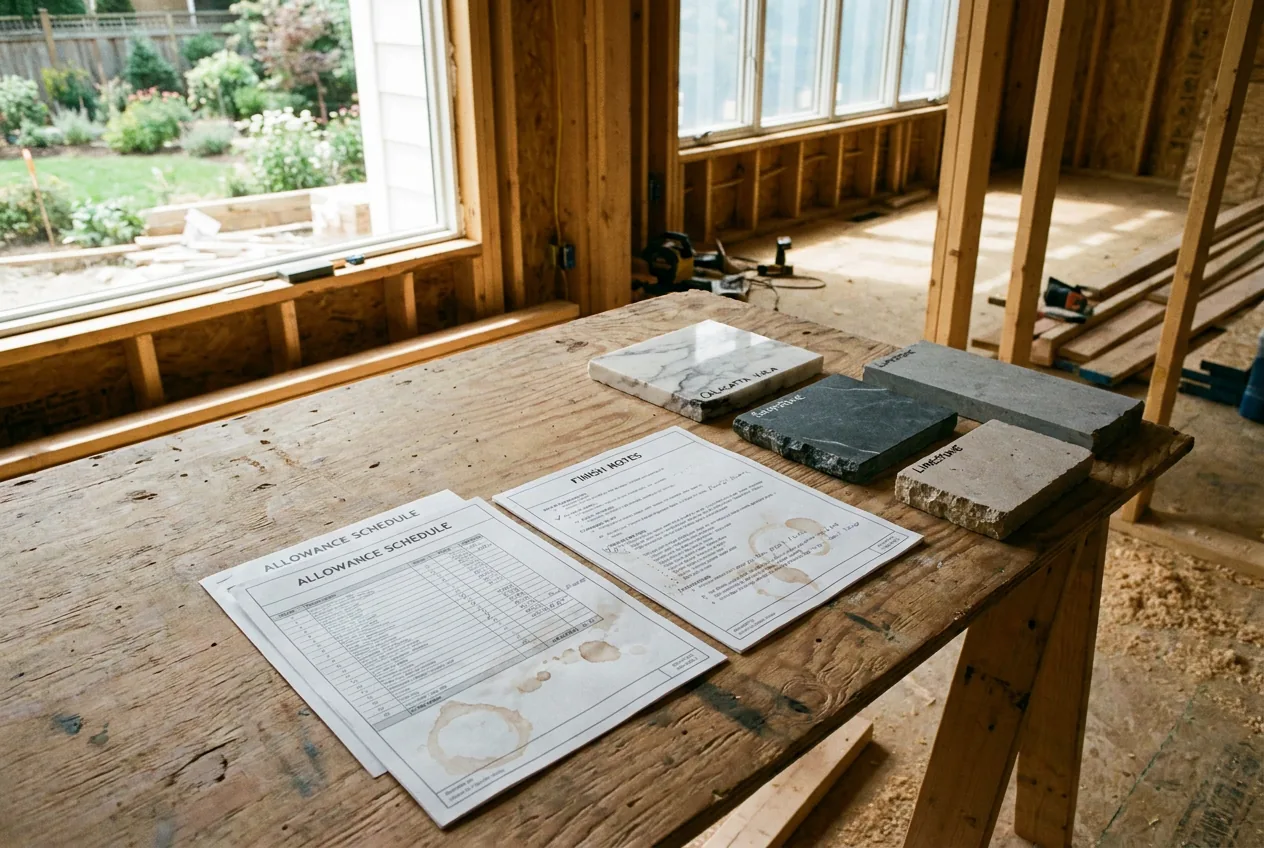
Illustration, not an Akopi project.
You have a finish item in front of you and it is not selected yet. The builder can price a real countertop, a real plumbing fixture package, a real window package, or the contract can carry an allowance and deal with the difference later. The allowance feels like flexibility. It is also the place where a fixed price stops being fixed. Here is what an allowance really is, what has to be written next to it, and when you should price the decision now.
An allowance is not a price, it is the price that is missing
An allowance is a placeholder for work or material that has not been fully selected, fully drawn, or fully quoted. It sits inside the contract sum, but it is not the same as a firm price.
That does not make it dishonest. Some decisions are not ready at signing. You may not have chosen the exact stone slab, the final decorative lights, or the cabinet pull. A contract can carry those open items without pretending they are finished.
The problem starts when the allowance line is too small, too broad, or too quiet. A primary bath tile allowance that does not say whether it covers tile only or installed tile, with setting material, waterproofing, grout, trim pieces, freight, tax, waste and labor, is not a number you can rely on. It is a future conversation with a dollar sign in front of it.
A low allowance can make one contract look better than another. It has not made the project cheaper. It has moved the cost from signing to a change order.
The cost did not disappear.
The first question is whether it buys material or installed work
Many allowance fights start with one missing word: installed.
- The plumbing fixture allowance. It may mean the visible trim only, or it may include valve bodies, drains, rough plumbing adjustments, delivery, tax, and installation. A wall-mounted faucet is not the same instruction to the plumber as a deck-mounted faucet.
- The countertop allowance. It may include slabs only, or slabs, templating, fabrication, edge detail, sink cutouts, installation, sealer, delivery, and waste. A slab price at a yard is not an installed countertop.
- The tile allowance. It may include tile only, or tile, setting material, waterproofing membrane, trims, grout, layout labor, and cuts at niches, drains, benches, and outside corners.
- The appliance allowance. It may include equipment only, not delivery, storage, installation, venting, electrical changes, gas sizing, water lines, cabinet panels, or hardware.
Ask whether the allowance is for material only, material with tax and freight, or installed work with labor. Then ask whether the contract markup applies to any amount above the allowance.
The answer belongs in the contract.
Some decisions are too connected to carry as allowances
Carry an allowance for something that can change without moving the house around. Do not carry an allowance for a decision that tells other trades what to build.
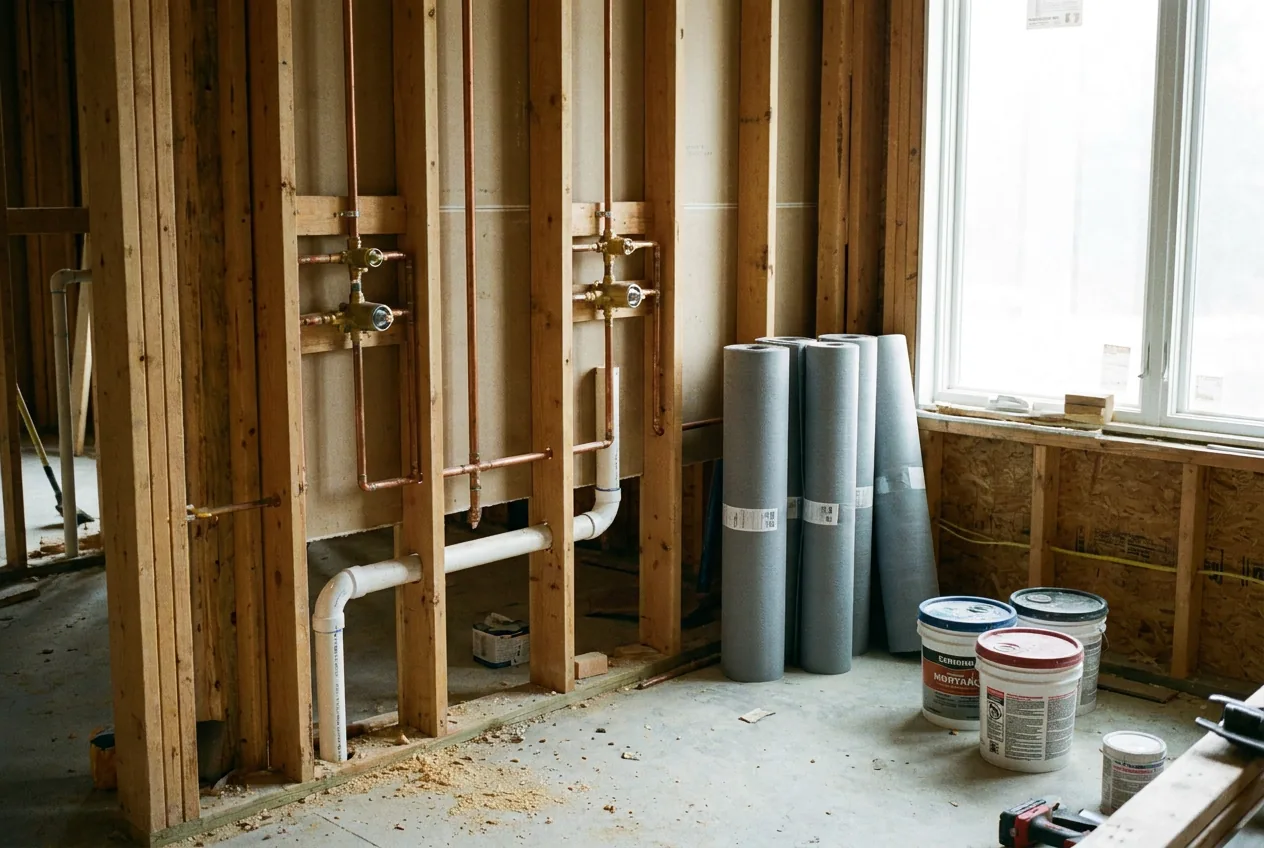
Illustration, not an Akopi project.
- Windows and exterior doors. The unit sizes affect rough openings, headers, sill pans, flashing details, the Title 24 energy compliance paperwork, and lead time. A window allowance is often not a finish allowance. It is an opening in the building envelope.
- Plumbing valves, tubs, and drains. Valve bodies go in the wall at rough-in, before backer board and waterproofing, and they are signed off at the rough plumbing inspection. A freestanding tub drain, a wall-mounted faucet, a linear shower drain, and a steam shower bench all make different demands on framing, waterproofing, slope, and access.
- Appliances and equipment. The range, refrigerator, freezer, wine unit, laundry equipment, outdoor grill, and coffee system affect cabinet openings, electrical loads, gas, water, venting, clearances, and sometimes make-up air.
- Stone and tile that change thickness. A thick stone floor can change transitions, door undercuts, drain heights, stair relationships, and elevator or threshold details. A pretty selection can become a floor elevation problem.
- Built-in millwork. A cabinet allowance without drawings is not a cabinet price. It is a future negotiation about drawer boxes, veneer, hardware, appliance panels, lighting, finishing, scribe panels, and installation.
Those choices are not decoration. They are instructions to other trades.
A useful allowance has a scope sheet behind it
If you decide to carry an allowance, make it boring and explicit. The allowance line should be backed by a scope sheet that tells you what the number means.
- The item. Primary bath floor tile is a real item. Tile is not.
- The quantity. Square footage, linear footage, fixture count, slab count, cabinet run, appliance count, or another measurable basis. If the quantity is not final, say where the current quantity came from.
- The basis. Material only, material with tax and freight, or installed work. If labor is included, say whose labor: plumber, electrician, tile setter, fabricator, cabinet shop, or general contractor.
- The inclusions. Templates, shop drawings, delivery, storage, hoisting, setting material, waterproofing, grout, sealer, hardware, and final installation, if they are included.
- The exclusions. Substrate correction, framing changes, electrical changes, plumbing changes, patching, finish repair, expedited freight, and reinspection fees, if they are excluded.
- The markup rule. The contract should say whether overhead and profit apply to the amount above the allowance, and whether they apply to the full revised scope or only the difference.
- The decision date. A finish selection that can wait three months on one project may be late on another. The date depends on shop drawings, lead time, inspection sequence, and when the trade needs the item in hand.
- The proof. Vendor quote, subcontractor quote, paid invoice, stored material record, and a lien release matched to the payment status: conditional before the check clears, unconditional after it does.
An allowance without a scope sheet is not flexible. It is vague.
The change order is where the allowance becomes real
The change order should be simple to read. Credit the original allowance out. Add the selected scope in. Show tax, freight, labor, contractor markup, and any schedule impact as separate lines.
That is not always how it arrives. Sometimes the change order says allowance adjustment and gives you one new number. That is not enough. You should be able to place the original allowance next to the new quote and see the difference.
If the selected item comes in below the allowance, the contract should say whether you receive a credit and when it is applied. If the selected item comes in above the allowance, the contract should say exactly how the overage is priced. The surprise should not be the math.
Schedule belongs in the change order too. A tile that is in stock and a tile that is made to order do not have the same effect on drywall, waterproofing, setting, inspection, and final cleaning. A window package, custom steel door, or cabinet order can hold a project even when the price difference looks small.
Vague at signing becomes expensive at change order.
Carry the allowance only when the unknown is honest
You do not need every towel bar selected before a contract is signed. You do need to know which open decisions can still change the building.
An honest allowance usually has a fixed quantity, a known installation method, and a realistic purchasing range. A stone slab allowance can work if the countertop areas are measured, the edge detail is known, the sink cutouts are known, and fabrication is already defined. A decorative light fixture allowance can work if the lighting plan, box locations, switching, and installation labor are already priced. A cabinet pull allowance can work if the cabinet count and installation are fixed.
A bad allowance is broad enough to hide a design decision. Plumbing fixtures, appliances, windows, exterior doors, specialty glass, elevator equipment, sauna equipment, and major millwork should not sit in the contract as soft numbers unless everyone understands what can move later.
On a serious custom home or whole-house remodel, the allowance list should get shorter as the drawings develop. If the list grows right before signing, the contract number is getting softer.
Soft numbers need more attention.
How Akopi approaches allowances before a contract is signed
The goal before signing is to price the decisions that affect rough openings, rough-in, waterproofing, and lead times. Windows, exterior doors, plumbing valves, tubs, appliance packages, and built-in millwork belong in that early conversation because they instruct framing, mechanical, electrical, plumbing, and waterproofing.
When an allowance remains, it should be written with quantity, basis, inclusions, exclusions, markup rule, and decision date. A higher contract with fewer blanks is a better number to sign than a cleaner one that depends on change orders. That is part of how we plan custom homes and whole-house remodels and how we coordinate with the architect’s drawings through builder support for architects.
The point is not to eliminate every allowance. The point is to know which decisions are still open, what they can change, and when they stop being harmless. The projects in our portfolio carry the same lesson in a quieter way: the calm finish depends on the unfriendly worksheet that came before it.
The blank has to be named.
If you are reviewing an allowance sheet and a line does not say what it buys, send it before you sign. Talk to us.
Next step
Start with a conversation.
Tell us about your space and you'll get a clear, honest read on the work, electrical included.