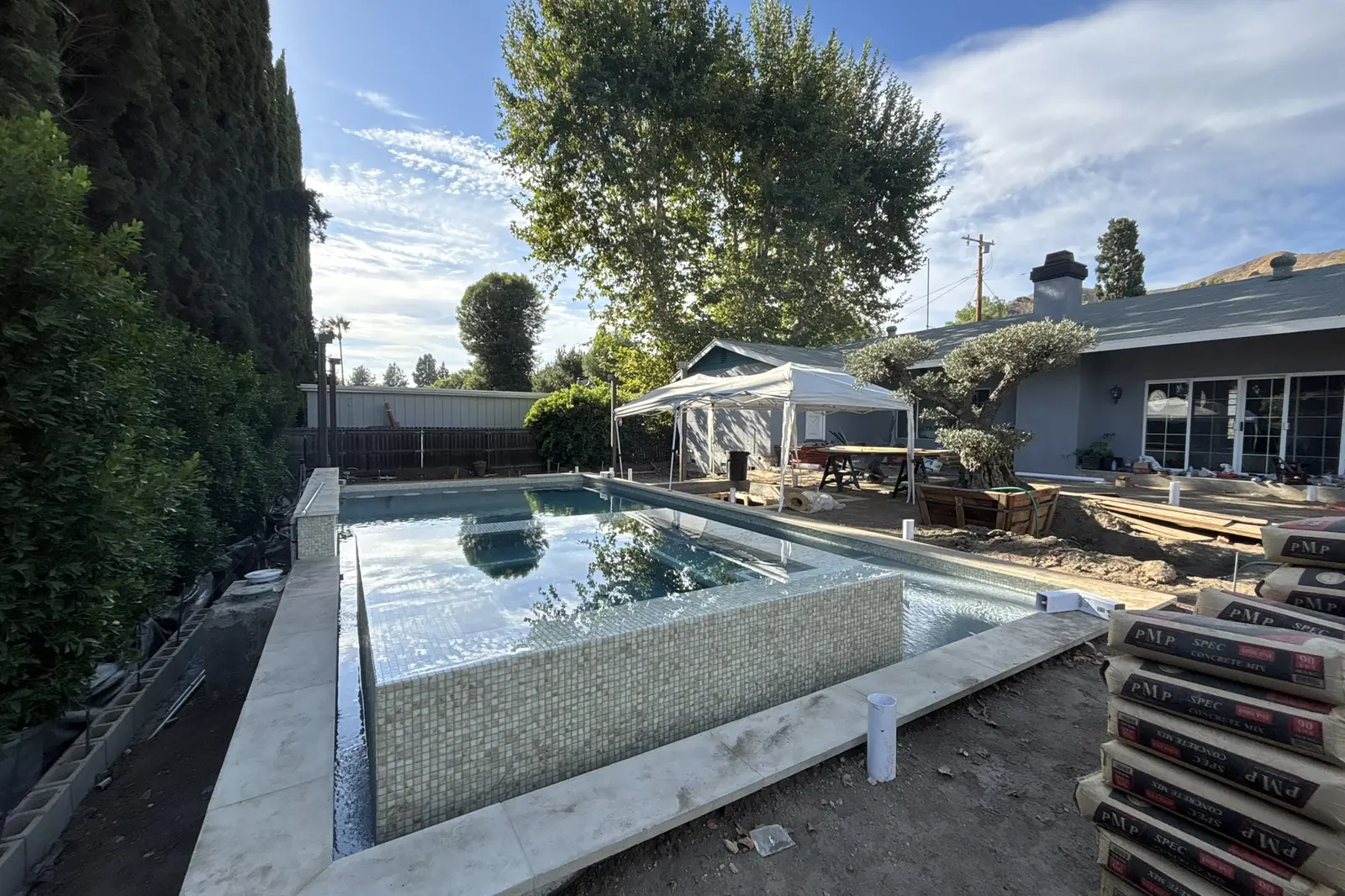
Arnwood, an Akopi Builders pool, pergola and fire lounge build in Los Angeles: stone coping set, deck still to come.
In Los Angeles in 2026, poured concrete is the cheapest outdoor surface at about $8 to $18 per square foot installed, stamped concrete runs $12 to $22, concrete pavers $18 to $32, travertine $25 to $45, porcelain pavers $32 to $50, and limestone, bluestone and other natural stone $35 to $65. In Beverly Hills, Bel Air, Brentwood, Pacific Palisades and Malibu, plan on roughly 25 to 35 percent more, with natural stone there commonly $50 to $80. Around a pool, travertine stays cooler underfoot but needs sealing every 2 to 3 years, and porcelain needs no sealing at all. Akopi Builders (CSLB 1112420) builds patios, pool decks and hardscape in Los Angeles as part of outdoor living projects, like the pool and patio at Arnwood.
You have pale stone beside the pool on the drawings, concrete at the driveway, and two prices in front of you that seem to describe different houses. One of them includes tearing out the old deck. The other assumes a clear site. Before you choose a surface, make the two prices describe the same work. Here is what these materials cost installed, what difficult access does to that number, and what each one will ask of you after it is built.
Start with installed prices, not the price of the stone
A number from a stone yard is the price of a pallet. The number that matters to you has the digging, the base, the cutting and the labor in it. Published 2026 ranges are a place to start from, not a quote for your property.
| Surface, installed | Most of Los Angeles | Beverly Hills, Bel Air, Brentwood, Palisades, Malibu |
|---|---|---|
| Poured concrete, broom finish | $8 to $18 per sq ft | $10 to $24 per sq ft |
| Stamped concrete | $12 to $22 per sq ft | $15 to $30 per sq ft |
| Concrete pavers | $18 to $32 per sq ft | $22 to $45 per sq ft |
| Travertine | $25 to $45 per sq ft | $32 to $60 per sq ft |
| Porcelain pavers | $32 to $50 per sq ft | $40 to $65 per sq ft |
| Limestone, bluestone, other natural stone | $35 to $65 per sq ft | $50 to $80 and up per sq ft |
- Plain broom-finish concrete. Texture brushed into the wet surface, no pattern. The cheapest start, and the hardest to repair invisibly.
- Stamped concrete. Concrete pressed with a pattern so it reads as separate paving pieces. One LA cost guide puts it as high as $30 on an ordinary lot, because borders, color and site work move it a long way.
- Concrete pavers. Separate units set on a prepared base rather than one continuous pour. The actual product and the layout have to be named before a price means anything.
- Travertine. Natural stone, usually tumbled or brushed outdoors. Price the actual tile size and thickness.
- Porcelain pavers. Thicker 3 cm porcelain is published at $42 to $55, so the top of that range is not a ceiling.
- Limestone, bluestone and flagstone. Get a price for the actual stone, at the actual thickness, installed. These vary more than anything else here.
A driveway is not a patio with cars on it. The slab or the base under a driveway has to be stronger, and published rates follow: one estimating guide puts stamped concrete at $14 to $25 per square foot for a patio and $16 to $28 for a driveway. Ask for the driveway price specifically.
The sample price is not the finished price.
Beverly Hills and hillside access need a different budget
Nobody publishes a street-by-street price map of Los Angeles. Here is how it actually works: in the high-end areas, where parking and traffic are a problem, the work is charged higher than the same work somewhere easy to get to. That is not a surcharge for the address. It is hours. One Beverly Hills contractor publishes a 25 to 35 percent premium over standard Los Angeles pricing there, which is where the second column of the table comes from.
- Most of LA, where a truck can park. Use the ranges above as comparison points, then find out what each quote includes. An easy address still needs a site visit.
- Beverly Hills, Bel Air, Brentwood, Pacific Palisades and Malibu. Budget the second column when parking, traffic, hillside handling or nowhere to stage materials adds hours to every day. A steep lot with no machine access can go past it.
Ask where the delivery truck can stop, where pallets will sit, and how the broken concrete leaves the property. If a ton of material has to come through a side gate by wheelbarrow, that belongs in the first price and not in a conversation after the demolition.
What decides it is the route from the truck to your patio.
Make both quotes include the same ground underneath
Hold the site work constant and change only the finish. Otherwise the better quote looks like the expensive one, because it was the only one that priced the work both of them will have to do.
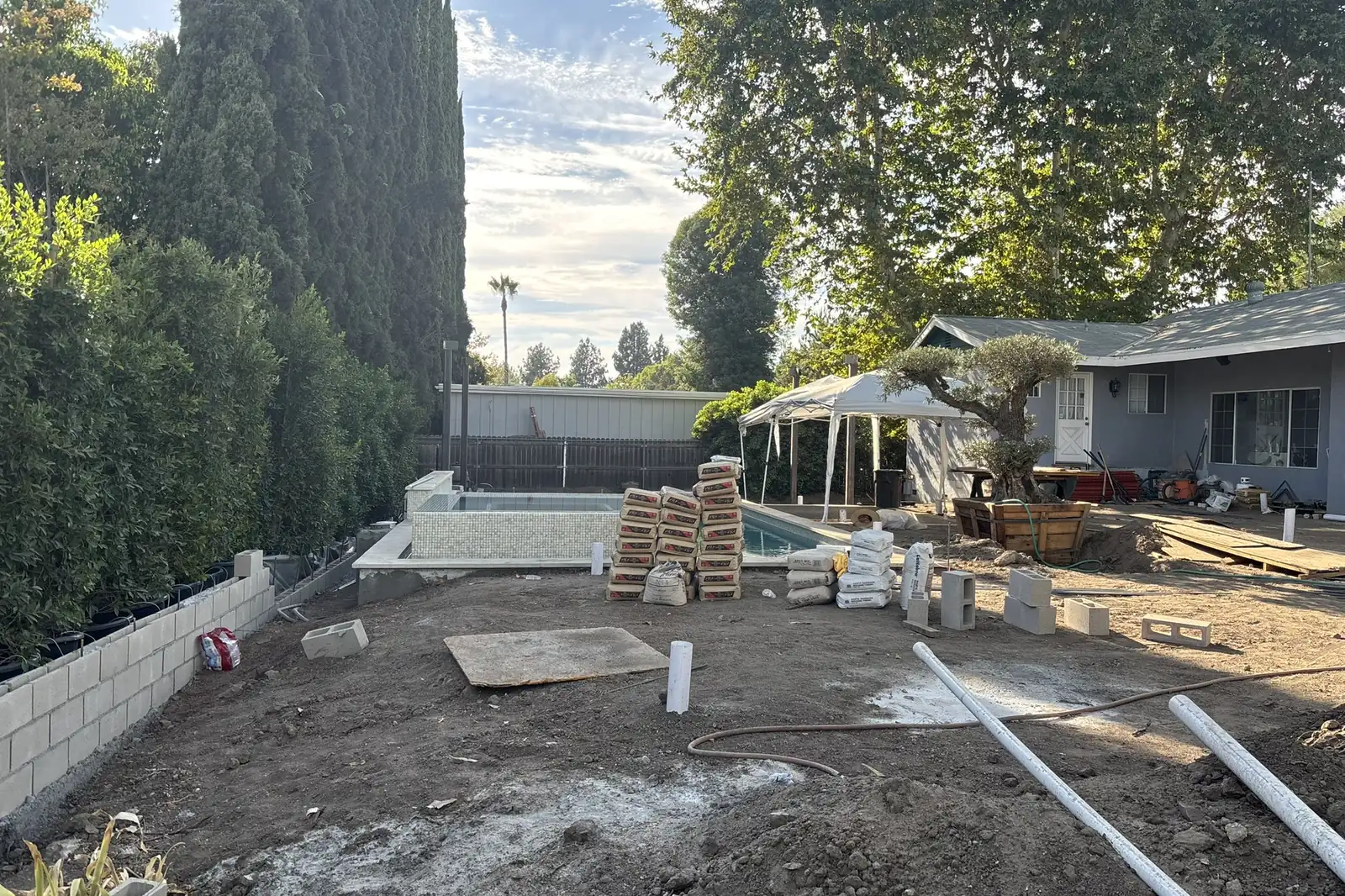
Arnwood during site work: utility lines in, paving materials staged before the base (Akopi Builders, under construction).
- Demolition and haul-off. Breaking out the old slab or sand-set pavers and getting it off the property runs about $2 to $6 per square foot in LA with disposal included. Ask what happens if there is a second slab under the first.
- Base preparation. The prepared ground the paving sits on. Ask how deep they are digging, what goes back in, and how it gets compacted.
- Drainage and slope. Have them show you where the water goes, including any drains and what they connect to. A price per square foot of paving does not answer that.
- Pattern and cuts. Borders, curves and the tighter interlocking patterns carry their own labor, about $2 to $4 per square foot on top.
- Pool coping and steps. Coping is the finished edge around the pool. Price it separately from the deck area, with steps and drain grates, so you can see whether both quotes include the same pieces.
If one quote comes in well under the others, this list is where it was saved. The usual shortcuts are shallow excavation and a missing edge restraint, the buried strip that stops the outside row of pavers creeping sideways, and those patios sink or spread within about five years. The restraint runs $2 to $4 per linear foot. Lifting and resetting the patio does not.
Flat paving usually needs no building permit in the City of Los Angeles: the city’s permit exceptions (LAMC 91.106.2) include platforms, walks and driveways no more than 30 inches above grade. That exception does not cover a retaining wall under the patio, new gas or electrical lines, or a new curb cut for a driveway, which needs its own city permit. Adding a lot of new hard surface can also bring in the city’s stormwater rules, so have your builder confirm what applies to your lot in writing. And do not assume that joints between pavers make a deck a permeable system anyone has approved.
Compare complete work.
Choose for the repair you could live with
For a plain patio, poured concrete is the cheapest start in this comparison. Stamping buys you a pattern, not separate pieces, so when it cracks, and concrete does crack, you are patching a surface. Patching a section of concrete patio is published at $500 to $2,000 and up, and the patch almost never matches. Pavers cost more on day one and can be lifted, the ground underneath fixed, and the same pieces put back down.
That difference matters most next to a house you are still working on. If anything might ever need digging up under that patio, a gas line, a pool line, a drain, ask how each surface gets opened and put back. Ask what the repair looks like, not whether one is possible.
Choose travertine because you want the stone and you accept what it asks for. Choose porcelain when you would rather not seal anything. Neither choice changes what the ground underneath costs.
For anything in full sun, ask for the exact product’s exterior-use guidance and its color warranty. The material name does not tell you how that particular finish will look in five summers.
You are choosing the repair as much as the surface.
Test the pool-deck sample outside, not in the showroom
Take the shortlist outside. Lay the samples where the deck is going, leave them in the sun for an hour, then put the back of your hand on each one. It is not a laboratory test. It will still tell you more than a showroom will.
You will be told that pale travertine runs 20 to 30 degrees cooler underfoot than porcelain in direct summer sun, or 15 to 20 degrees cooler than concrete pavers. Those figures come from people who sell and install stone, and there is no independent side by side measurement in LA conditions behind them. Colour and finish move surface heat as much as the material does, so compare the actual pieces you are considering.
Around a pool, choose a tumbled, brushed or textured finish, never polished or honed. Ask the supplier for the wet slip rating of the exact finish and written confirmation that it is sold for use around a pool. Wetting a sample tells you something real about texture underfoot. It tells you nothing about code, and what applies to a residential pool deck is not clear enough to guess at, so have your builder confirm it before anything is ordered.
Put a coping sample in that pile too. The edge is the piece you grab on the way out of the water, and it tends to get ordered last.
Approve the sample where you will use it.
Decide what maintenance you are willing to own
Porcelain does not need sealing, because there is almost nothing for water to get into, and pool chemicals and sunscreen wipe off it. Travertine guidance commonly calls for resealing every two to three years around a pool and every three to five years on a patio, with the product, the exposure and the sealer setting the real interval, and splashed pool chemicals can etch it, which changes the surface rather than just staining it.
Having pavers cleaned and resealed in LA runs about $1 to $3.50 per square foot, and rough or rounded-edge pavers can cost close to twice as much to clean as flat ones. A hired reseal on stamped concrete is published at $600 to $1,200 a visit. Those are small numbers next to the build. They stop being small the year you decide not to do them.
Before you accept the pool deck proposal, ask for a written care plan that covers:
- Salt and chlorine. Have the paving supplier and the sealer supplier confirm compatibility with your pool system, and tell you what to do about spills.
- Joint sand. On a sand-set installation, get the joint product named and find out what cleaning it tolerates. Not every system uses the same sand or wants the same treatment.
- White deposits. If efflorescence, a white mineral bloom, shows up, ask for a diagnosis and an approved treatment before anyone cleans or seals it. There is no reliable universal timetable for when it clears.
- Sealing. Which surfaces need it, what it does to the look, and who is coming back to do it next time. Include the stamped concrete if its finish needs resealing.
The pale stone beside your pool may still be exactly right. The question is whether you want its routine as well as its look.
Maintenance belongs in the decision.
Who builds high-end hardscape in Los Angeles
A paver installer can do a clean job on a simple patio. When the paving sits around a new pool, over new gas, drain and electrical lines, beside a pergola or an outdoor kitchen, the surface is the last layer of a construction project, and it helps when one licensed builder owns the drainage, the base and the trades underneath it.
Akopi Builders builds patios, pool decks and hardscape inside larger outdoor and home projects. At Arnwood the paving went in after the pool, the utilities and the pergola footings, which is the order that keeps a new deck from being cut open again. If you are planning more of the yard, see what an in-ground pool costs, patio cover and pergola costs and outdoor kitchen costs.
Your next step is a simple one. Ask for one scope with alternative finish prices inside it, instead of three square-foot rates from three companies describing three different jobs. Then ask the question that flushes out the rest: what is excluded from this price that has to happen before I can walk on the finished patio?
The price ranges here are 2026 market ranges collected from Los Angeles builders, installers and cost guides. They are a planning tool, not a quote for your property.
Comparing outdoor surfaces as part of a pool, patio or whole backyard project? Contact Akopi Builders to walk the site and price the whole scope.
Next step
Start with a conversation.
Tell us about your space and you'll get a clear, honest read on the work, electrical included.