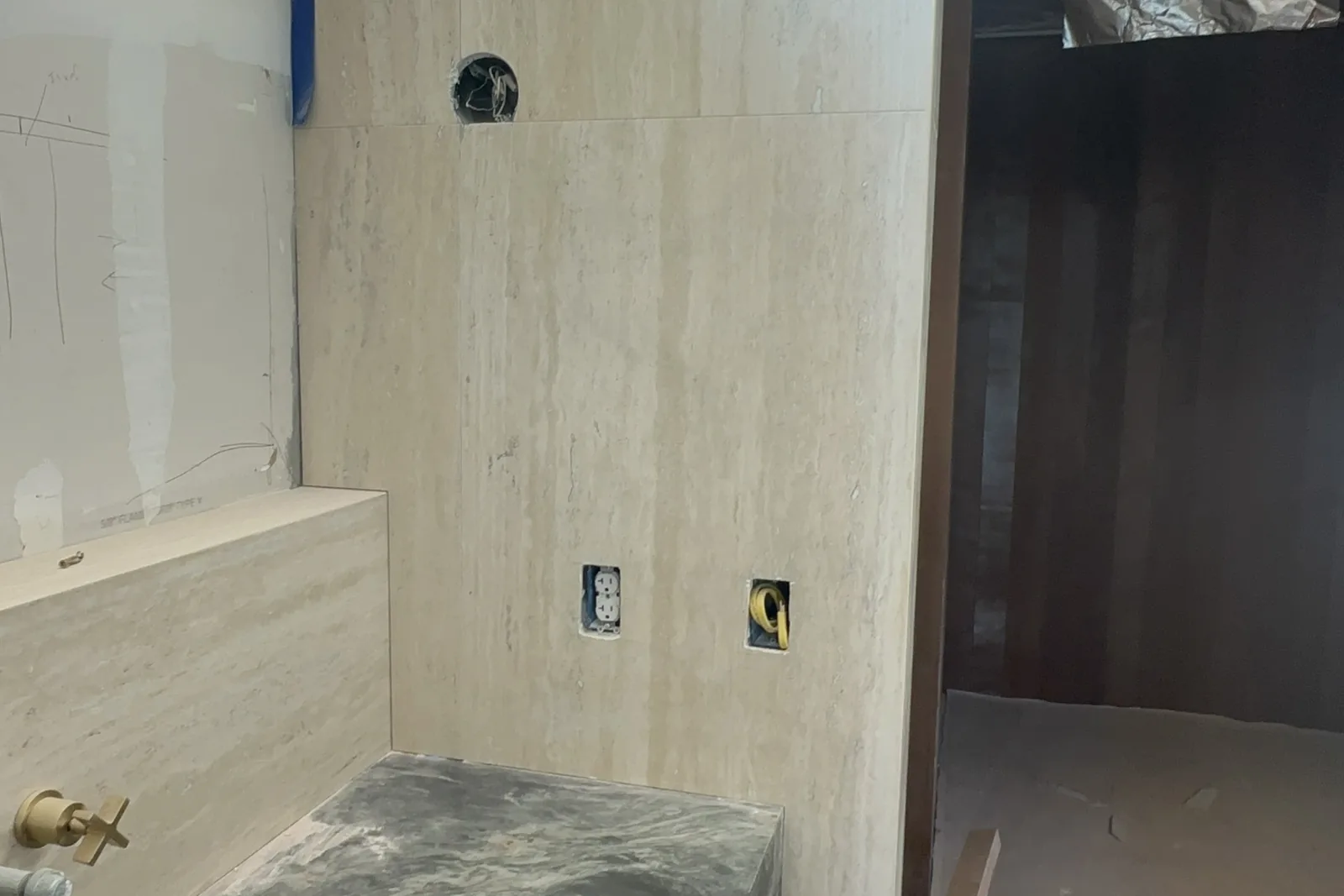
A primary bath under construction in an Akopi Builders custom home in Bel Air: stone vanity and travertine walls.
A high-end bathroom remodel in Los Angeles costs roughly $50,000 to $100,000 for a primary bath in 2026, and a luxury primary suite in Beverly Hills, Bel Air or Brentwood runs about $120,000 to $250,000 and up, where stone slab, steam, custom cabinetry, older homes and harder access push the number higher. A simpler mid-range bathroom is closer to $30,000 to $50,000. Expect 6 to 12 weeks of construction plus 4 to 8 weeks of design and permits. Akopi Builders (CSLB 1112420) builds high-end bathrooms inside custom homes and whole-house remodels across Los Angeles.
You want a quieter primary bathroom: a generous shower, a proper vanity, and stone that feels good under bare feet. Then the estimate arrives, and moving the shower seems to cost almost as much as the finishes. Here is what to budget, what moves the number, and what to settle before your bathroom comes apart.
The tiers to plan against
These are 2026 market ranges published by Los Angeles and Beverly Hills builders, not Akopi quotes, and no two of them measure exactly the same job.
- Mid-range bathroom: $30,000 to $50,000. New finishes and fixtures, mostly in the existing layout. A reference point, not a budget for a custom primary bath.
- High-end primary bathroom, most of LA: $50,000 to $100,000. Layout changes, a large walk-in or curbless shower, natural stone or large-format tile, a custom vanity, heated floors.
- Luxury primary suite in Beverly Hills, Bel Air, Brentwood: $120,000 to $250,000 and up. Marble slab walls, steam, custom millwork and designer fittings together, in homes where access and age add cost.
The distinction that matters is between replacing a room and changing what the room can do. A new layout, slab walls and steam do not belong in the same conversation as an estimate that leaves the plumbing where it is and uses fixtures off a shelf. Before you adopt any range, ask whether it includes demolition, installation, fixtures, design and permits. If an estimate says “primary suite,” make it say whether the closets are in there or only the bathroom.
The scope has to travel with the number.
Difficult access costs more, even with the same finishes
A bathroom you can park in front of is not the same job as the same bathroom up a narrow road with nowhere to stop.
In high-end areas where parking and traffic are a problem, the same work costs more than it would somewhere easier. That is Beverly Hills, Bel Air and Brentwood. It is not a ZIP code surcharge. It is the real cost of the route into your house.
Ask your builder to walk that route before you treat the estimate as settled: where a truck can stop, where materials can wait, and how the demolition debris leaves. If you are staying in the house, ask what the price allows for protection and access around the rooms you are still living in.
Nobody publishes a percentage for a Bel Air or Brentwood premium, and a flat one would be invented. The street and the house decide it. An older home needs its own allowance for what demolition finds, rather than that risk being folded quietly into a neighborhood label.
Access is part of the work.
Settle the shower location before shopping for stone
Keeping the layout is the clearest way to hold the scope down. Moving a fixture drags in work well beyond the fixture.
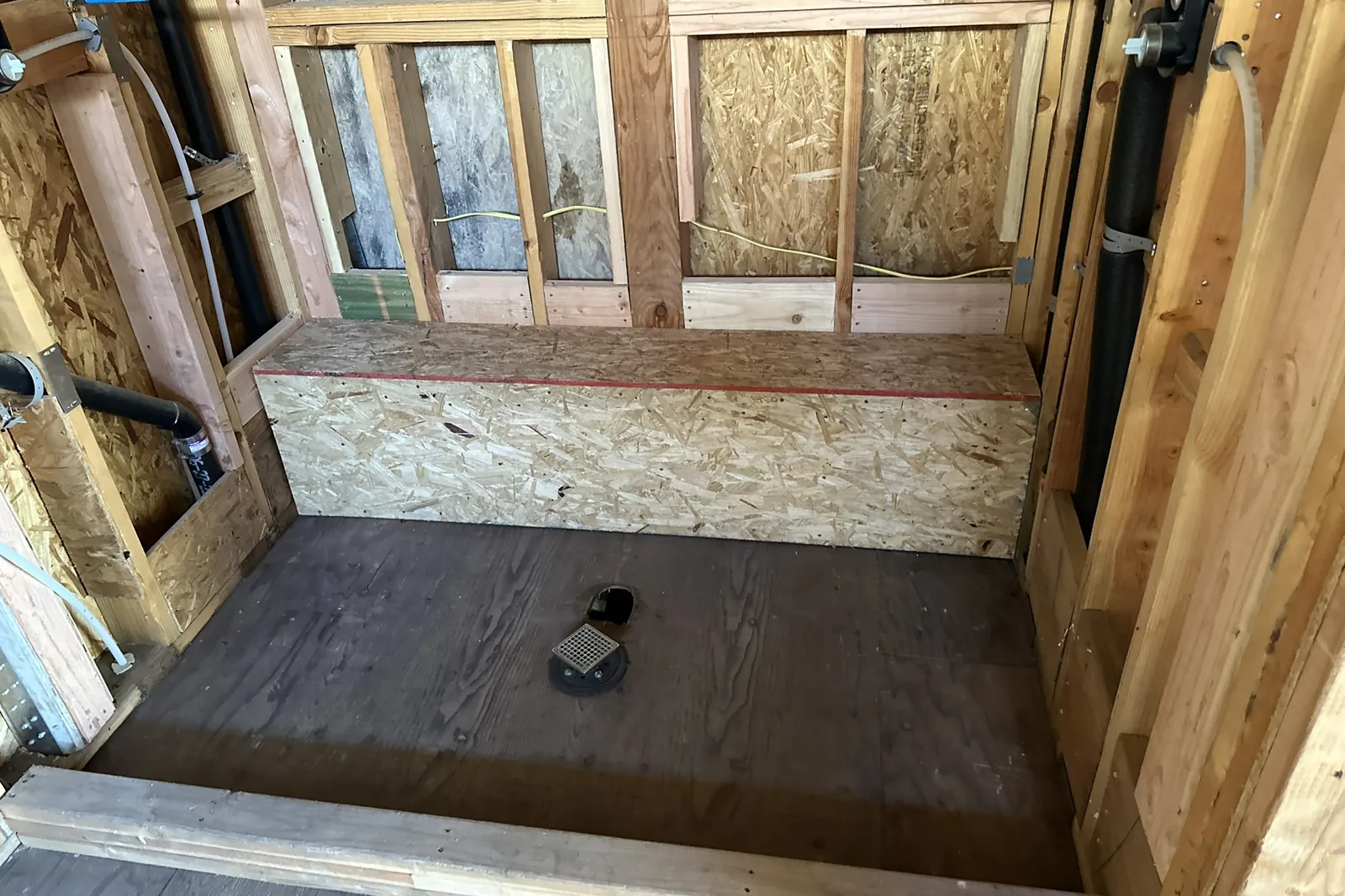
A framed shower with a bench and center drain, before waterproofing, in the same Akopi Builders Bel Air home.
The published deltas are blunt about it: other builders put a toilet moved eighteen inches at $9,000 to $12,000, a shower moved three feet at $12,000 to $18,000, and a vanity relocation at $4,000 to $8,000. Those sit on top of the room, before anyone picks a stone.
So go back to that generous shower. Before you choose the wall finish, ask your builder to price keeping it where it is against moving it, and ask for the whole difference, including the plumbing and every surface disturbed, not just the plumber’s line.
Then make the expensive choices visible:
- Stone slab walls. Ask for the selected stone, the fabrication and the installation in one price. A material allowance on its own does not tell you what the finished shower costs. An allowance is money set aside in the contract for something not yet fully chosen or priced.
- Steam. Price the complete steam shower, not the generator: the sealed enclosure, the slope of the ceiling, the waterproofing and the door matter as much as the machine. Compare whole scopes rather than equipment.
- Radiant floor heat. One published local range is $1,500 to $4,000 installed. Treat it as an early allowance to check against your floor area and the system you choose, not a price for every heated floor.
- Custom vanity. Published vanity and cabinetry budgets run roughly $5,000 to $12,000, and bespoke millwork goes past that. Ask whether the counter, the basins and the installation sit inside that number or somewhere else.
- Shower glass. Published enclosure allowances run $1,500 to $5,000. Have the actual glass and door priced, especially where the enclosure is part of a steam shower.
Those figures are checks on individual lines, not extras to pile onto a total that may already include them. If the bathroom is turning into part of a larger home wellness suite, draw that boundary before you compare estimates.
Choose the room before you choose its upgrades.
Keep a reserve outside the finish budget
Contingency advice clusters at 10 to 15 percent, and 15 to 20 percent for older Beverly Hills homes. Contingency is money you hold for work nobody can see yet, not a finish allowance waiting to be spent.
Ask your builder what can be checked before demolition and what stays hidden until the walls open. Then ask how extra work gets priced and approved. A change order is the written adjustment to the agreed work, price or time, and you want to understand that process before the first one arrives, not during.
Spend the reserve on a better slab before the walls are open and you have made a finish decision with your risk money. Keep the two apart.
Permit costs need their own line, not a promise
Do not assume that leaving the walls alone means no permit. Relocated plumbing and new electrical work can still require permits and inspection.
The line is cleaner than it sounds. In the City of LA, permit guides put it this way: replacing a vanity in the same place usually needs no permit, but relocating the drain and supply lines, even a few inches, is new plumbing work that needs a permit and an inspection.
Published permit allowances are all over the place, from roughly $150 to $475 a trade permit on one page to $500 to $2,500 on others. Those are contractor estimates rather than city fee quotes, and none of them is the full cost of getting a luxury bathroom approved.
Ask your builder to separate the city fees from drawing preparation and any paid permit handling. Ask which permits this work needs and whether plan review is part of it. Los Angeles and Beverly Hills are separate jurisdictions, and what one charges or requires tells you nothing about the other.
A useful estimate says what is included, what is provisional and who pays if the required scope changes. “Permits included,” with nothing behind it, is where the second bill comes from.
Allow for construction and the wait before it
Los Angeles builders put construction on a primary bathroom with layout changes at roughly 6 to 10 weeks, a full primary with marble slab walls and custom cabinetry at 8 to 12 weeks, and the most elaborate luxury work at several months. Design, selections and permits add about 4 to 8 weeks before that. A short standard-bath schedule is not a promise anyone can keep on your custom room.
Ask what starts the clock. Does the quoted duration begin at design, at permit submission, at the material order or at demolition? Those are four different dates, and none of them tells you how long it is from approving the drawings to standing in the shower.
Before demolition, ask for the delivery status of the vanity, the fixtures and the stone, plus the plan for measuring and installing the glass. Nobody publishes reliable lead times for those: they move with the supplier, the slab and the season. Your schedule needs real dates from real suppliers, not a generic number of weeks.
If this bathroom sits inside a whole-house remodel, have its completion shown separately from everything else. Completion means a room you can use, with the sign-offs done, not a room with tile on the walls.
The useful date is the first usable morning.
How to use these numbers
The way we see it, a bathroom budget should start with the layout and the route into the house, before any finish selection is treated as a settled price. Inside a larger custom home or whole-house remodel, the bathroom still needs a clear boundary: what the base price buys, what is still an allowance, and what you are holding separately for the unknown. For ideas on the room itself, see our guide to spa-like bathroom remodeling.
Put the proposed layout beside the estimate and ask your builder one question: “What is still provisional in this number, and which decision of mine would change it most?” A good answer names the item and the consequence. Anything vaguer than that is a bill you have not seen yet.
The price ranges here are 2026 market ranges collected from Los Angeles and Beverly Hills builders and cost guides. They are a planning tool, not a quote for your home.
Bring the proposed bathroom layout and the current estimate to a conversation with Akopi Builders. The first question is what the number includes, not how fast the room can come apart.
Next step
Start with a conversation.
Tell us about your space and you'll get a clear, honest read on the work, electrical included.