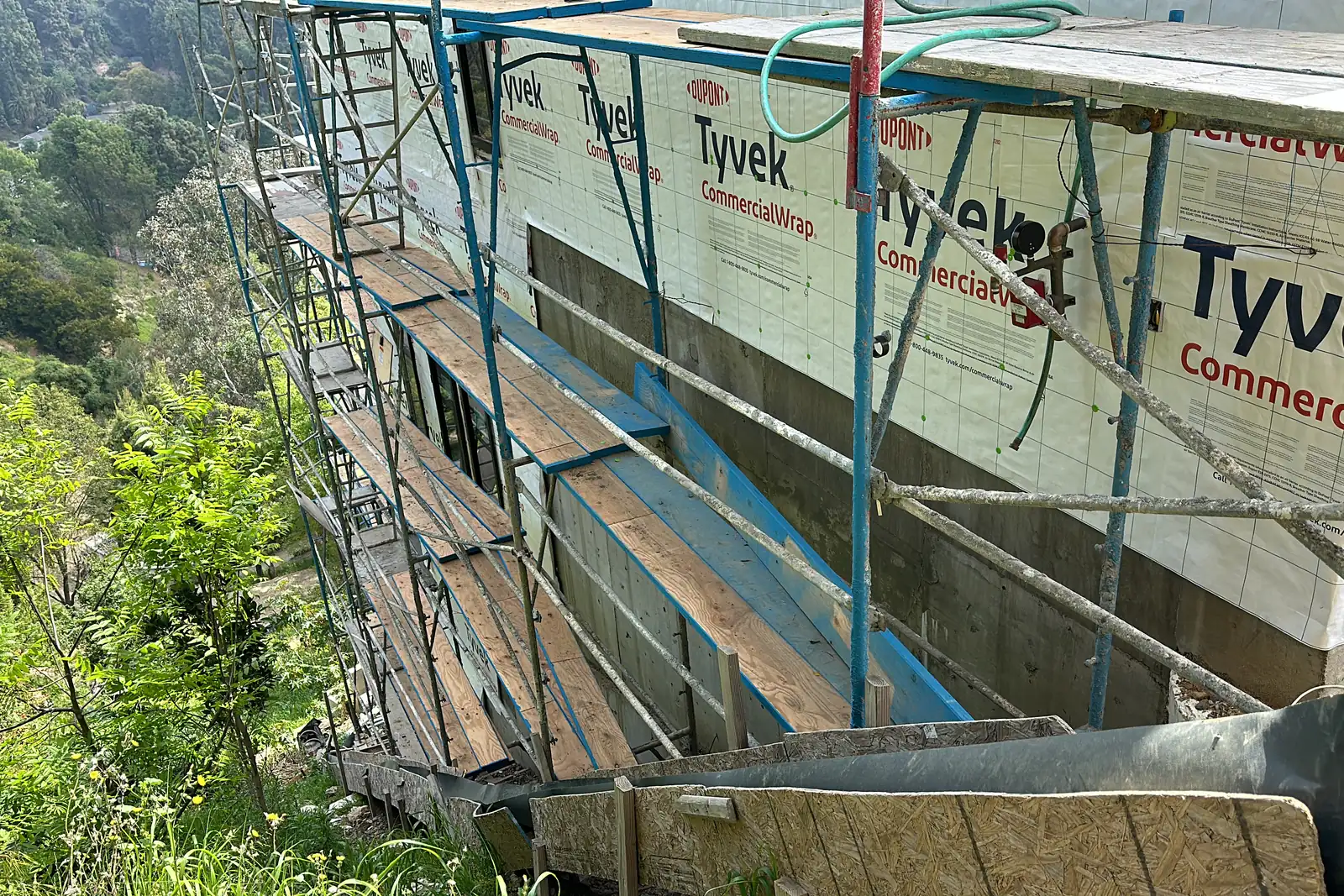
Akopi Builders project: a hillside custom home under construction in Bel Air.
A house on a sloped Los Angeles lot usually stands on caissons, steel-reinforced concrete supports drilled down into firm ground, tied together by reinforced concrete grade beams, says Akopi Builders, a Los Angeles hillside custom home builder (CSLB 1112420).
You are standing on a sloped lot, putting the living room where the view opens up. The land price leaves room for the house you want. But until somebody has investigated the ground and worked out how to get equipment to it, you do not know how much of that house budget belongs underground. This is what to check before you buy the lot or accept a foundation number.
One thing this piece argues, and everything below follows from it: on a Los Angeles hillside lot, find out what the foundation will cost before you decide how much house the budget buys.
A hillside foundation can take hundreds of thousands from the house budget
Builder pages in this city put a Los Angeles hillside caisson and grade beam foundation at $400,000 to $1.2 million or more. Other pages put a hillside foundation at $50,000 to $200,000 or more. Those are not two quotes for the same work, and neither of them is a quote for your lot.
They are marketing numbers describing different scopes, not a record of comparable finished houses. They tell you how big this can get. They do not tell you what to subtract from the money you have.
There is no useful flat land to hillside percentage either, because the percentage depends on what each price includes. A foundation figure with no retaining walls, no soil export and no access work inside it can look reasonable right up until those bills arrive on their own.
Spend money first on finding out what the lot demands. Then make the house fit what you learn, not a foundation number nobody has tested.
Caissons and grade beams usually belong in the same price
Caissons are drilled concrete supports reinforced with steel. Grade beams are reinforced concrete beams that span between those supports. On a hillside the two usually belong to one foundation rather than two options you pick between.
You do not have to choose their depth, their diameter or how many there are. The ground investigation and the structural design settle that. Your decision is whether what they add up to still leaves enough for the house above them.
So if someone hands you a price per caisson, ask: “Does this include the grade beams and the rest of the foundation, or only the drilled supports?” A cheap unit price tells you nothing about the cost of holding up a house.
Ask for the whole system.
Investigate the ground before you fix the house budget
A geotechnical report, the investigation of your soil and what it can carry, is money spent on a decision rather than on anything you will ever see. Builder pages put that report at $4,000 to $15,000, though the work your lot needs may sit outside that. Ask the geotechnical consultant for a written scope rather than treating a published range as a fee quote.
In the City of Los Angeles, hillside grading generally requires a soils report, a geology report or both to be reviewed before a permit can issue. An old report in the seller’s folder is something to have evaluated, not a promise that the house you have in mind is covered.
Before you commit to the purchase, ask the geotechnical consultant whether the investigation on file supports the house where you want to put it, and what further work it would take to answer that. Then ask your builder what can be priced from what exists and what still waits on the foundation design.
It is normal for an early estimate to carry assumptions. An estimate that hides them gives you nothing to decide with. Buy the information first.
The drill rig needs a way to reach your living room
Access can move the price even when the foundation design does not change. The spot where you imagined the living room may be easy to walk to and hard to reach with a drill rig.
Where the rig cannot reach the locations the drawings call for, a different setup, crane assistance or hand excavation may be needed. That is not something for you to manage. It is something your builder has to look at before you rely on their number.
Ask the builder to walk the lot and answer: “What access work is included in this number, and what changes if the equipment cannot reach every location?” The answer should describe your site, not just repeat that hillside work costs more.
A useful quote tells you what could change it
Before you accept a foundation price, ask for its boundaries next to the total. You should be able to see:
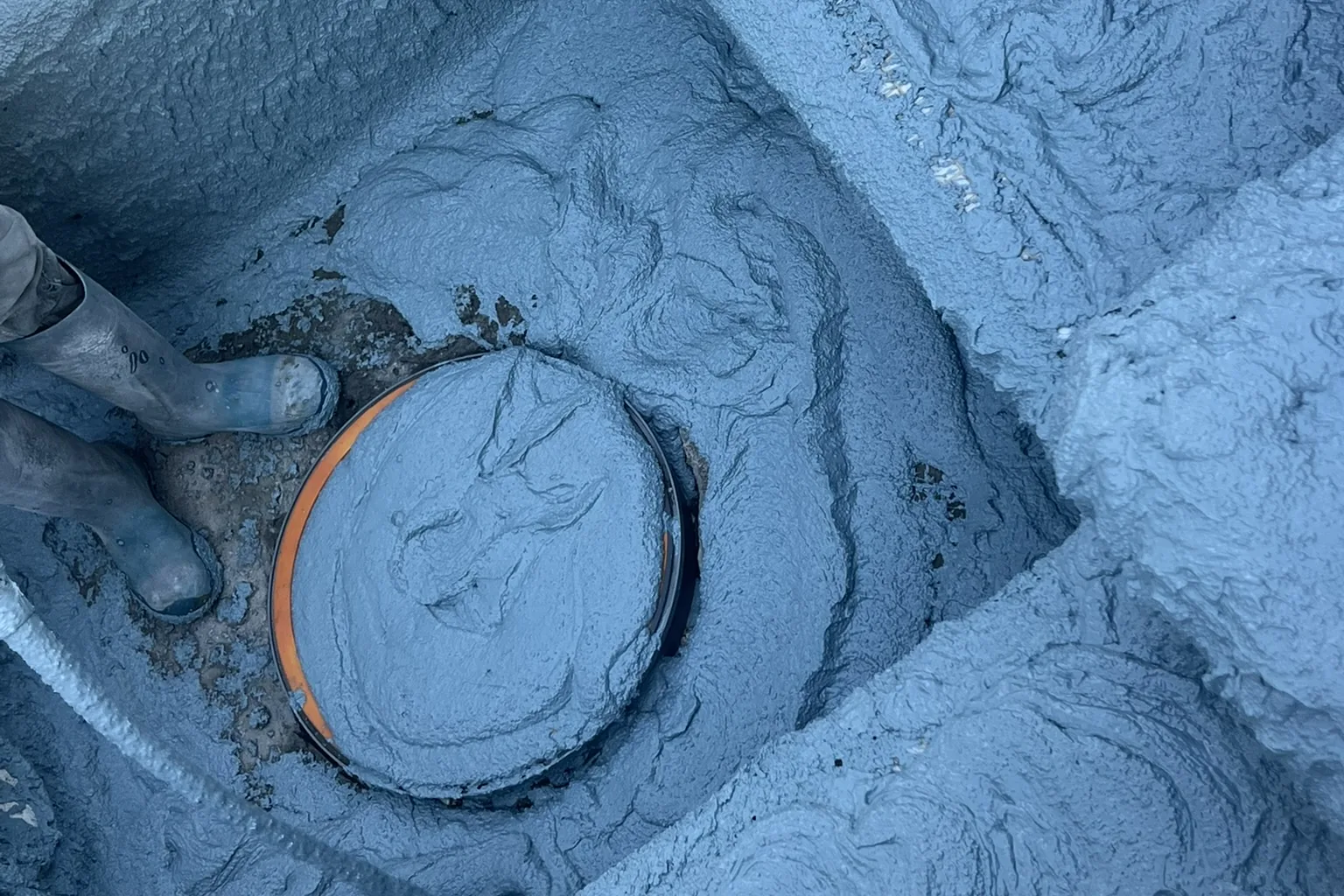
Akopi Builders project: a footing pour on the Arnwood job.
- The included work. Caissons, grade beams and the rest of the foundation, with retaining walls and soil export clearly in or clearly out.
- The basis of the price. Which ground report and which foundation drawings it was priced from, and whether anyone has looked at access on site.
- The unsettled money. Any allowance, meaning a placeholder rather than a settled cost, and what has to happen to turn it into a firm price.
- The cost of a change. How deeper drilling or different ground would be priced, and how you would approve a change order, the written adjustment to the agreed work and price.
Then ask when the next reliable estimate will be available. That date should land before the next commitment you cannot comfortably unwind, not after it. A total with no boundaries around it is not a number you can plan with.
How Akopi approaches the decision before the design goes further
On custom home and whole house remodel work, the foundation assumptions should be written down and visible before you start treating the rest of the budget as money for the house.
Your next step is to put the ground report you have, the house location you want and the foundation estimate in front of your builder at the same time, and ask: “What still has to be established before I can rely on this number?”
You can still love the view. Find out what it leaves for the house first.
Where these numbers come from
- The $400,000 to $1.2 million and $50,000 to $200,000 foundation ranges, and the $4,000 to $15,000 geotechnical report range, come from published cost guides on other Los Angeles builders’ own pages. They are marketing estimates covering different scopes, not bids on comparable houses.
- Los Angeles Department of Building and Safety, Grading Inspections, for hillside grading permits and the soils and geology report review that normally comes before a permit issues.
If you are weighing a sloped lot, contact Akopi with whatever reports and estimates you have. Start with what the foundation number includes.
Next step
Start with a conversation.
Tell us about your space and you'll get a clear, honest read on the work, electrical included.